

Job interviews are a critical step in the hiring process, and they come in various formats depending on the industry, company culture, and role. Here’s a detailed look at the ten most common types of job interviews, each with its unique approach and purpose. 1. Traditional One-on-One Interview In a traditional interview, you meet with a single interviewer, usually a hiring manager or supervisor. This format is ideal for assessing your qualifications, experience, and fit for the role. It’s the most common type of job interview, often conducted in-person or virtually. 2. Panel Interview A panel interview involves a group of interviewers, typically from different departments or functions. This format allows the interviewers to gauge how you interact with a team and assess your responses from multiple perspectives. It’s common in government jobs, academia, and larger corporations. 3. Group Interview In a group interview, multiple candidates are interviewed simultaneously. This setting is often used to assess teamwork, communication, and leadership skills. Group interviews are common for roles that require strong interpersonal skills, such as sales or customer service. 4. Behavioral Interview Behavioural interviews focus on your past experiences to predict future behaviour. Interviewers use questions based on the STAR (Situation, Task, Action, Result) method, asking you to describe specific situations and how you handled them. This format is popular because it helps interviewers understand your problem-solving skills and teamwork abilities. 5. Case Interview Case interviews are common in consulting and finance. The interviewer presents a business problem or scenario, and you are expected to analyse and propose a solution. This format assesses your analytical skills, creativity, and ability to think on your feet. 6. Technical Interview Technical interviews are designed to assess your technical knowledge and skills. They are common in IT, engineering, and other technical fields. Expect coding challenges, problem-solving exercises, and technical questions related to the specific role. 7. Phone Interview Phone interviews are often used as a preliminary screening step before a face-to-face interview. They allow employers to gauge your communication skills and confirm basic qualifications. Phone interviews are generally shorter and focused on getting to know you briefly. 8. Video Interview Video interviews have become more common with the rise of remote work and virtual communication tools. They offer flexibility and can be conducted from anywhere. Video interviews are similar to traditional interviews but require additional preparation for technical issues and camera presence. 9. Lunch or Dinner Interview These interviews are more informal and typically occur in a restaurant or café. The purpose is to evaluate your social skills, etiquette, and how you conduct yourself in a less formal setting. This format is common for roles that require client interaction or high-level business meetings. 10. Stress Interview Stress interviews are designed to test your ability to handle pressure. The interviewer might ask difficult questions, use silence, or create a challenging atmosphere. Stress interviews are rare but are sometimes used for high-pressure roles in finance, emergency services, or security. Conclusion Understanding the different types of job interviews helps you prepare effectively for each format. Each interview type has its own dynamics, and the key to success is being adaptable, confident, and well-prepared. By familiarising yourself with these common interview styles, you’ll be better equipped to tackle any interview that comes your way.

Navigating the Talent Sea: The Indispensable Role of Recruitment Agencies
In today’s bustling job market, the hunt for top talent has many familiarities to searching for a needle in a haystack. With hundreds of applicants applying for a single role, the task of identifying the perfect fit can be daunting for any hiring manager. In such a scenario, recruitment agencies emerge as invaluable partners, wielding expertise, and efficiency in navigating this sea of talent. The Deluge of Applicants Picture this: a job opening is posted, and within hours, the floodgates open. Resumes pour in by the dozens, then hundreds. Each applicant brings a unique set of skills and experiences, making the selection process akin to piecing together a complex jigsaw puzzle. However, amidst this abundance lies the challenge – how does one sift through this mountain of applications to find the gems? The Burden of Sifting Sifting through a cascade of resumes is no mean feat. It demands time, precision, and a keen eye for detail. Yet, for many hiring managers already juggling multiple responsibilities, dedicating hours to resume screening can be a luxury they can ill-afford. Moreover, the risk of overlooking a potentially ideal candidate looms large amidst the sheer volume of applications. The Art of Shortlisting Enter recruitment agencies – the unsung heroes of the hiring process. With their expertise honed through years of experience, they possess the unique ability to skilfully navigate this labyrinth of CVs. By employing sophisticated screening techniques and leveraging their industry insights, they can swiftly identify the most promising candidates, sparing employers the arduous task of wading through endless piles of resumes. The Intrinsic Value of Agencies Beyond mere shortlisting, recruitment agencies offer a range of intrinsic benefits to employers. From streamlining the hiring process to ensuring compliance with employment laws, they serve as trusted advisors, guiding employers through every step of the recruitment journey. Moreover, their vast networks and access to passive candidates widen the talent pool, presenting employers with a diverse array of options to choose from. Conclusion In a job market teeming with talent, the role of recruitment agencies cannot be overstated. They serve as beacons of efficiency amidst the chaos, offering employers a lifeline in their quest for top-tier talent. By shouldering the burden of CV screening and shortlisting, they enable employers to focus their energies on what truly matters – finding the perfect fit for their organisation. In essence, recruitment agencies are not merely service providers; they are strategic partners, indispensable in today’s competitive landscape.
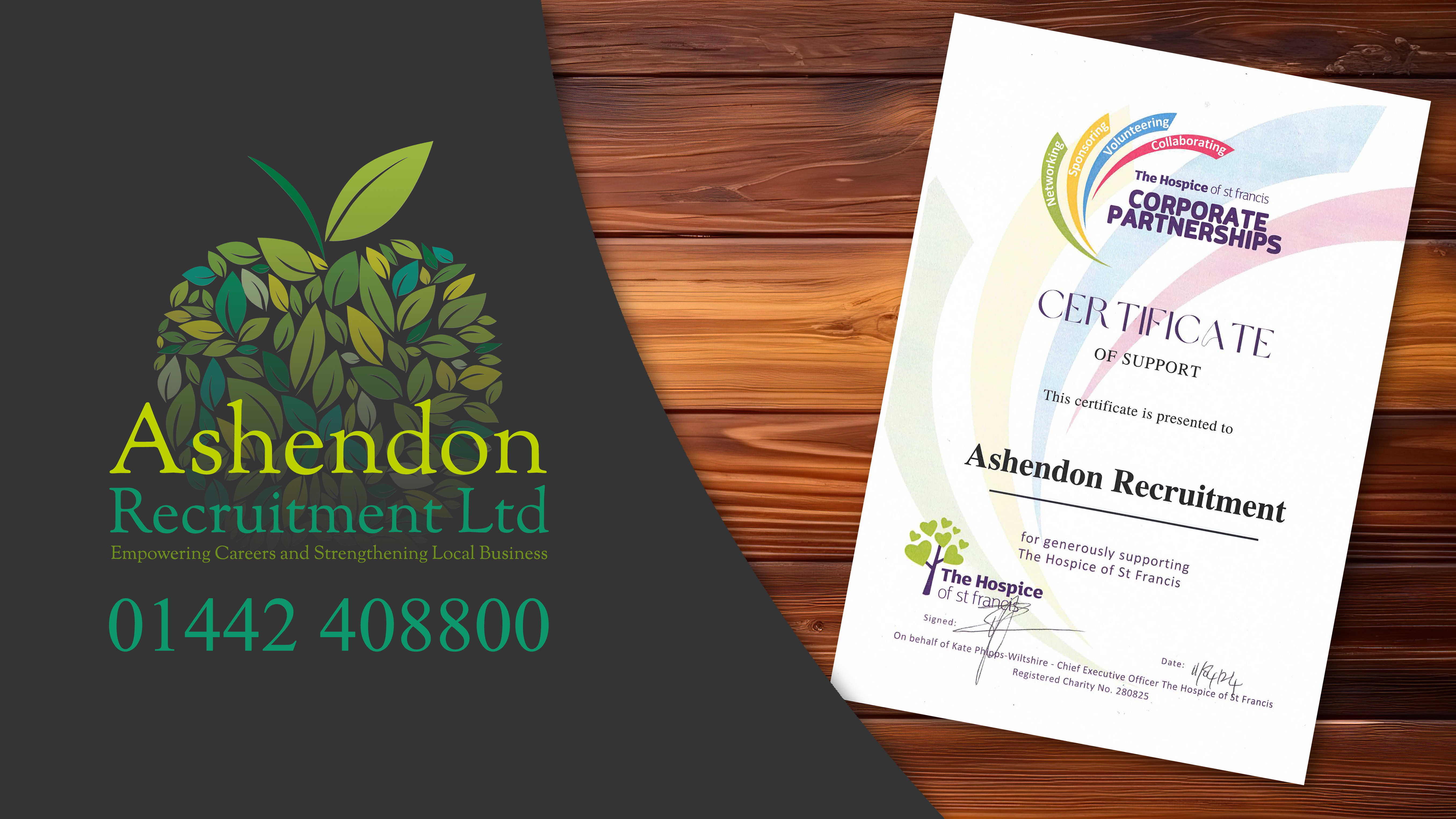
Ashendon Recruitment are accepted as Corporate Partners to The Hospice of St Francis
Ashendon Recruitment are proud to have been accepted as Corporate Partners to The Hospice of St Francis in Berkhamstead. Click to view The Hospice of St Francis is a charity which helps 2,000 local people and their families, in Hertfordshire and Buckinghamshire, to live their precious lives well through improving symptoms, achieving personal goals and helping them to feel safe. As part of our commitment to improving and helping to strengthen services to people in our local community Ashendon Recruitment is committed to working with the Hospice of St Francis and in joining the Corporate Partner Network we have made a long-term commitment to them, and we will do all that we can as a business to support the good work that they do. We will keep you all informed of Ashendon Recruitments’ involvement with them and any exciting new ventures we start together. The Hospice of St Francis ethos is always to provide exceptional care – an ambition recognised by the Care Quality Commission (CQC), the independent regulator of health and adult social care in England, who awarded them an ‘Outstanding’ rating in 2016. Based in beautiful surroundings just outside Berkhamsted, there care is provided completely free, and they look after people in Hemel Hempstead, Berkhamsted, Tring, St Albans, Harpenden, The Chalfonts, Chesham, Amersham and everywhere in between. They also support people in local hospitals and care homes. As well as exceptional end of life care they also provide Complementary Therapies, Social Care, Carers Support, Childrens Services, Creative Therapies and Spiritual Support and Advice. At The Hospice of St Francis they are also passionate about supporting people to live well so they run a number of specialist services including a Pulmonary Fibrosis Support Group, bereavement counselling and extended family support services. If you ever need to access any of the support that The Hospice of St Francis provide, please complete their confidential self-referral form or give them a ring on 01442 869550. A member of their administration team will acknowledge your enquiry within one working day. Alternatively, do speak to your GP who can also refer you to their services.